The church exterior reflects the Victorian restoration of 1862 whilst the interior has reverted to a more simple style following the post fire restoration of 2010 to 2013. The building, which has a Grade II' listing is known to date from at least 1275; some parts may have earlier origins.
The church stands on raised ground set well back from the road at the point of a spur which projects into the Brede valley. At this point an ancient track-way crossed the River Line, a tributary of the Brede. The track-way was broad and crossed the river by a ford in a forest clearing, thus named a "leah ford", from which has come Leeford and the Leeford Place Hotel almost opposite the church. Shrines and chapels where wayfarers could offer prayers were often built on such Sites. The Doomsday Book of 1086 records that "Earl Harold held Watlingetone", Harold was Earl of Wessex, in January 1066 he was crowned Harold Il, King of England, succeeding Edward the Confessor.
Harold's short reign ended with his untimely death at the Battle of Hastings defending England from the invading Normans, the fateful battle taking place just up the road on 14th October 1066, (In the Doomsday Book he is referred to as Earl Harold, the Normans omitting that he was the anointed King of England). The Doomsday Book continues "The Manor was worth 50 shillings and has been waste", reflecting how the Normans laid waste to the surrounding countryside. In the Doomsday Book, Eckwall gives Whatlington as meaning 'wheat-field settlement.
An ancient Yew tree stood in the churchyard until it fell in the storms of 1987; its wood was subjected to Dendrological testing which showed it to have been already aged in 1066. The precise age could not be determined as the centre of the trunk had rotted away to create a cavernous hollow, its age and presence would suggest that there may well have been an earlier church on the site. The hollow of the Yew became a trysting place for the young couples of the village.
From close to the Yew a view could be obtained across the valley to a point where on the further slopes at which the London to Hastings stage coach could be seen to approach, drawn by its team of horses. It is said that as the coachman began the descent into the valley he would call out, turn your coats up Gentleman. It's cold in Whatlington." And whip up the horses to gain enough momentum to carry the coach up the rise towards Battle, round the left hand bend in the road and briskly past the entrance to the church - close to the hollow in the old yew, for within it, having watched the approach of the coach may have been concealed the local highwayman.
It is known that there was a chapel at Whatlington prior to 1200, because Simon de Echyngham (Etchingham) retained his "rights" in it when granting lands to William de Haremere about the end of the 12th century.
Harold held the lordship of Watlingetone' and was a Sussex man it is reasonable to suppose he would have has some knowledge of the area when preparing for the battle. The Saxon army assembled prior to the battle on Caldbec Hill, about a mile further along Whatlington Road towards modern day Battle. Before the London Road was diverted along the course of the present A21 it ran down to Battle through Whatlington, it is thus likely that the Saxons would have passed this way on their march.
Hope Muntz, in her historically based fictional novel "The Golden Warrior", has Harold hearing Mass at a Chapel nearby. Local folklore, handed down through the generations, tells that members of Harold's personal guard were hanged in chains from the boughs of the Whatlington Yew, an apocryphal story. (After The Conquest, Watlingetone formed part of the large estates, granted by Robert, Earl of Eu, to Reinbert, founder of the House of Echyngham.) In 1205, the Chaplain of Whatlington, according to the "Robertsbridge Charters", was Warin the son of Gilbert de Dumare. In 1252, William, son of Simon de Echyngham bequeathed his "rights" in the chapel to the Abbot of Battel (Battle).
In 2011 Dendron dating of the roof frame timbers showed them to date from 1275, the present building must have been built by either Ralph de Coventry, the tenth Abbot of Battel, or his successor, Reginald. In 1291 the Advowson was with the Abbey of Battel and was worth £4 13s 4d, in 1299 it was recorded that Whatlington was taxed seven marks in Pope Nicholas's taxation.
15th Century to the Present Day
"Through fire and restoration, the church continues to thrive."
Some alterations to the church probably took place in the 15th century, as the first and fourth windows in the South wall possess the exterior square labels of the period. In 1538, after the dissolution of Battle Abbey, King Henry VIII granted the Advowson (Benefice) of Whatlington to Sir, Anthony Browne, his Master of Horse.
Sir Anthony became the first domestic resident of the Abbey. He has a fine memorial near the altar in the church of St. Mary the Virgin Church, Battle, It has doubtfully been attributed on stylistic grounds to the Florentine sculptor Torrigiano, a pupil of Michelangelo, who made the tomb of Henry V11 in Westminster Abbey. It remained in the family of Viscounts Montagu until 1685. Towards the end of the 17th century the patronage had come into the hands of Lionel, Duke of Dorset, and remained in that family until 1877. In 1877 the "living" was inherited by the first Lord Sackville and remained with the Sackville's, when Benefice united with that of nearby Sedlescombe in 1924 under Ernest Reid, Lord Sackville and the Lord Chancellor became alternate patrons. The Whatlington Rectory, now a private house stands next to the Village Hall.
By the 1850's the church is said to have fallen into a state of disrepair, this led to a major restoration paid for by public subscription and completed in 1862. The work was overseen by a little known architect S.W. Tracey. In common with so many medieval churches subjected to Victorian restorations the work was extensive, changing the character of the building in line with ideas common at the time, though at the same time perhaps saving it.
The timber north porch and the bell tower at the west end of the roof were taken down and replaced by the present NW tower with its substantial tiled broach spire, described by Pevsner in his 'Buildings of Sussex' as being 'unfortunate'.
The oak bell frame, believed to date from the 17* century was moved into the new belfry. At the West end a new stone faced brick gable was raised and the two lancet windows were replaced with a new but unremarkable cinquefoil window. This in common with the new Nave windows was glazed with opaque glass with a rose tinted border. The Chancel and East Window glass is believed to date from this time. The roof was boarded in and a series of timber frames of dubious structural value were built in to replace the tie beams, which it was discovered in 2010 had been cut away. The oak roof plate beams with their carved leaves and moulded sides were retained and remained visible.
New pitch pine pews were installed, standing on pine floor boards which in turn were fixed to oak beams laid directly on the earth floor. The Nave walls were boarded in to the height of the pews. The oak choir stalls and a pair of oak Bishops chairs were also introduced.
A new boiler fed a heating pipe running up the centre of the tiled aisle below a cast iron grating, the Chancel and Sanctuary floors were also tiled. The alterations included a new staged gallery, possibly replacing an earlier one at the west end, this later housed an organ set to one side and possibly introduced in the early 1900's.
A replacement organ installed in 1937, paid for by subscription by parishioners and was positioned across the centre of the gallery, thus completely obscuring the West window. The organist sat with his back to the gallery front with just a slender rail to prevent him leaning too far back! The organ was supplied with air by means of a hand pump; an electric blower was fitted after the Second World War. Oil lamps hung from the roof.
The East gable retains its ancient coping. In the corners of the chancel, on corbels, were two small sculpted heads, said to represent King Edward I, the reigning sovereign when the church was built, and Eleanor, his Queen. These corbels were of necessity removed during the restoration, following extensive cleaning they were replaced in 2014 into a new and more visible position at the east end of the Nave, where the walls return for the Chancel.
The north doorway is a plain arch opening and mainly modern. The west wall has been partly rebuilt and contains a plain doorway of two orders. The rather plain lead lined font is of an unknown date, it has an oak cover with wrought iron strapping. The bowl is a plain square with chamfered angles and an octagonal shaft with a square base.
The carved oak altar, with its linenfold panels was presented in 1933 by Hilda Gripper, in memory of her parents. The brass chandelier is said to be 18th century Flemish work, it was given by the late Reverend F. J. Browell in the 1930's, it fell in the fire and was badly damaged. A large carved oak pulpit supported by three angels, together with the large oak eagle lectern were introduced, designed by the Reverend Hatchard of St. Leonards these are understood to have been crafted in France. These items were said to have been exhibited at the Great Exhibition of 1851 at The Crystal Palace. Research in 2017 through the V & A has however shown this to be incorrect, with no evidence in the catalogue of any church furnishing.
The Vestry was added in two stages, the apsidal part dating from the 1860's with the longer part having been built on in 1908, funded by the Hon. Thomas Brassey of Catsfield, giving us the building as you see it externally today. The weather vane on the spire, erected in 1994, commemorates former organist Ken Crouch who died in 1986.
The church hall was built in 1888 at a cost of £120 (Kelly's Directory 1903), It was purchased from the P.C.C. of St. Mary Magdalene in 1956 by Whatlington Village.
The fire of 15th July 2010
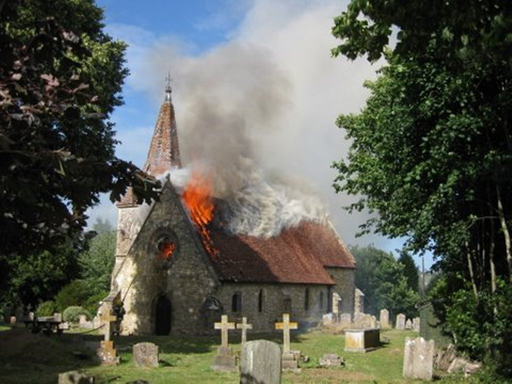
Thursday 15th July 2010 was a fine but windy summer's day, the church was locked and had last been used for a funeral on the Monday of that week. A neighbour noticed smoke near the church and at first thought it was a bonfire in the churchyard, she soon however realised that the building was on fire. The fire is thought to have been caused by an electrical fault in the organ reading light - which was switched off.
Having started in the organ the fire soon spread into the Victorian roof timbers above the Gallery. The heat caused the west window to blow out causing a wind tunnel in the void above the boards, the fire then rapidly spread through the roof causing the tiles to pop off. The internal boarding fell as the fire spread along the void wreaking havoc below. A total of eight fire engines attended with fire fighting hampered by a lack of water nearby, causing foam to be used instead. The roof frame continued to smoulder for several hours after the main fire was extinguished and a policeman spent the night keeping watch in the porch.